The fair way to split tax and tip on a group bill
By Mitch R, Tab Tender Team · 5 min read · Updated August 8, 2026
Split tax and tip in proportion to each person's share of the subtotal, not evenly — an even tip split overcharges whoever ordered the least.
Most people carefully split the food by who ordered what, then split the tip evenly — and accidentally undo all the fairness they just created. Here's how tax and tip should actually be divided, and why.
On this page
- What's the most common mistake splitting tax and tip?
- Why is a proportional split fairer?
- What does a proportional tax-and-tip split look like?
- Tip on pre-tax or post-tax?
- Should you just double the tax to get the tip?
- What about service charges and auto-gratuity?
- Should you tip on the tax?
- How do you split the tip when one person didn't drink?
- Is a flat amount per person ever fair for tip?
- Let the tool do the percentages
What's the most common mistake splitting tax and tip?
Imagine two people: one orders $60 of food, the other orders $20. They correctly each pay for their own food. Then they split a 20% tip ($16) evenly — $8 each. The light eater just paid 40% of the tip on 25% of the food. That's backwards.
Tip and tax scale with the size of an order, so they should be divided the same way the food is.
Why is a proportional split fairer?
Tax is literally a percentage of the subtotal, and a percentage tip is too. If your food was 25% of the table's subtotal, your fair share of a percentage-based tax and tip is also 25%. Splitting them proportionally simply keeps everyone's slice consistent from the subtotal all the way to the final total.
What does a proportional tax-and-tip split look like?
Say the subtotal is $80: Person A ordered $60, Person B ordered $20. Tax is $7 and the tip is $16, for a $103 total.
Proportional split: A's share is 60/80 = 75%, so A pays 0.75 × ($7 + $16) = $17.25 on top of their $60 → $77.25. B pays 25% → $5.75 on top of $20 → $25.75. The two totals add up to $103, and each person carried tax and tip in line with what they ordered.
Tip on pre-tax or post-tax?
Either is defensible; tipping on the pre-tax subtotal is slightly more common and arguably more correct since you're tipping on the food and service, not the government's cut. The bigger fairness lever is splitting whatever tip you choose proportionally, not whether the base included tax.
Should you just double the tax to get the tip?
It is the most quoted shortcut at an American table, and it only works in a handful of places. Doubling the tax gives you a tip of exactly twice your local sales tax rate, and that rate varies enormously: the population-weighted average combined state and local rate is about 7.5%, which doubles to roughly a 15% tip, below the 18% to 20% most people leave today. In Louisiana, Tennessee, Washington, Arkansas, and Alabama, where combined rates run about 9.5% to 10%, doubling lands close to 19% or 20% and works fine. In Delaware, Montana, New Hampshire, and Oregon there is no sales tax at all, so doubling it tips nothing.
One thing the rule can never do is divide the result. Whatever tip you arrive at, the fairness question is still how it gets split across the table, which is the whole point of the proportional method above.
Check your own receipt rather than a state average. Restaurant meals are often taxed differently from general retail, and plenty of cities add a separate meals tax on top, so the rate printed on your bill is the only one that matters for this shortcut.
| Combined sales tax | Doubling it tips | Where that lands |
|---|---|---|
| 0% (Delaware, Montana, New Hampshire, Oregon) | 0% | Nothing at all. The rule is meaningless here. |
| About 1.8% (Alaska, local rates only) | About 4% | Far below any standard. |
| About 5% | About 10% | Well short of a normal restaurant tip. |
| 7.5% (the US average) | About 15% | Under the 18% to 20% most people now leave. |
| 9.5% to 10% (Louisiana, Tennessee, Washington, Arkansas, Alabama) | 19% to 20% | About right. This is where the shortcut earns its reputation. |
Source: Tax Foundation, State and Local Sales Tax Rates, Midyear 2026 (July 2026)
What about service charges and auto-gratuity?
Large parties often get an automatic gratuity (commonly 18–20%) baked into the bill. If it's already there, don't tip again on top by accident. Split the existing service charge proportionally just like a tip, and only add more if the group decides the service warranted it.
Should you tip on the tax?
Tipping on the pre-tax subtotal is the more common convention — the tip is for the food and the service, not the sales tax. On a small check the difference is pennies; on a large group tab it might be a dollar or two. Pick one approach and apply it to everyone. The fairness that actually matters is splitting whatever tip you land on proportionally, not whether the base included tax.
How do you split the tip when one person didn't drink?
Alcohol is usually the biggest swing in a group bill, so this comes up constantly. Because a proportional split ties each person's tip to their own items, the non-drinker automatically pays tip only on their food — no special-casing required. Split the tip evenly instead and the person who skipped the $14 cocktails quietly subsidizes everyone who didn't, which is the exact unfairness proportional splitting removes.
Is a flat amount per person ever fair for tip?
A flat per-head tip (say $8 each) is fast, but it's an even split in disguise — it overcharges the small orders and undercharges the big ones, just like dividing the whole total by the number of people. It's fine among friends who ordered similarly; for a mixed table, a percentage of each person's own subtotal stays fair with no extra effort once a tool is doing the arithmetic.
Let the tool do the percentages
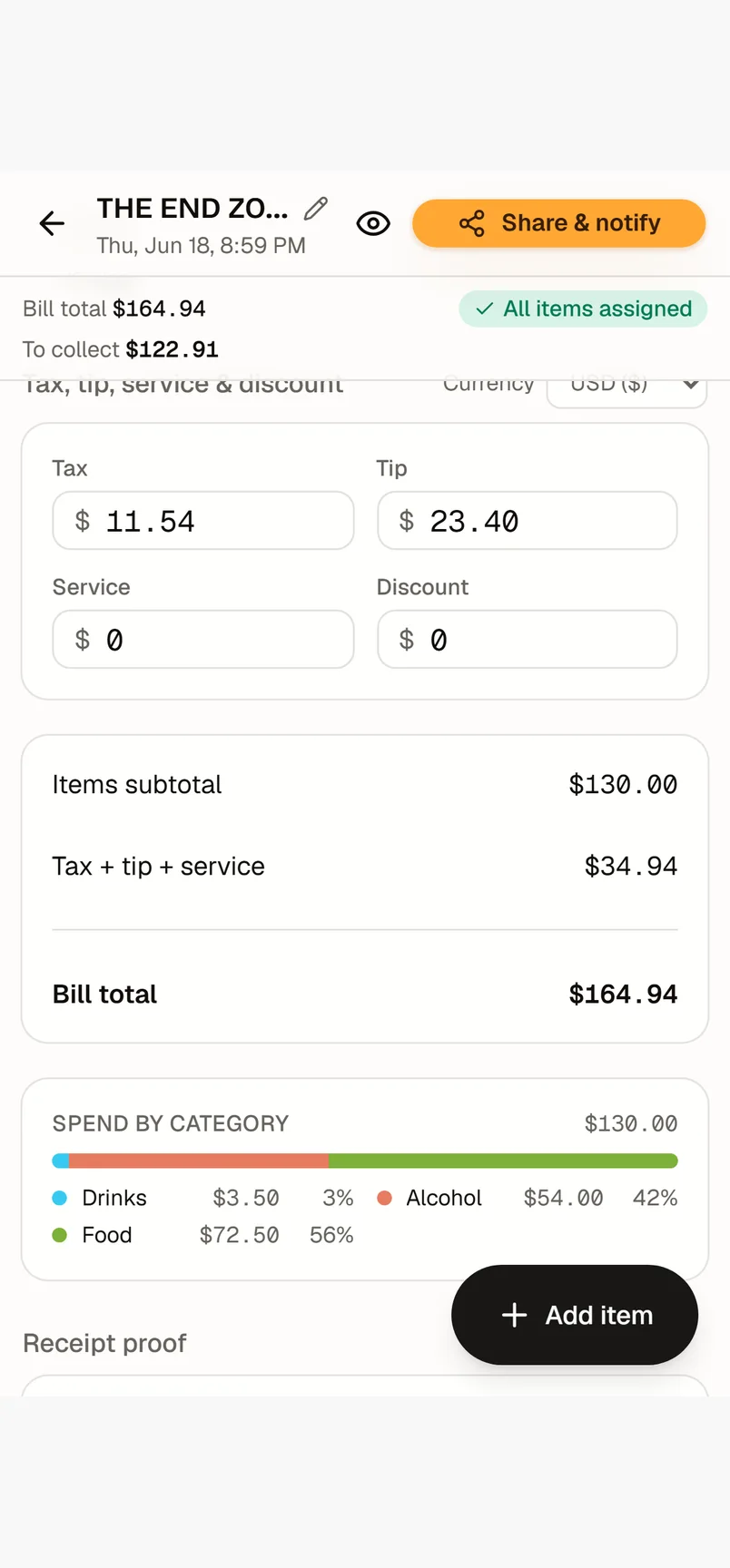
Tab Tender distributes tax, tip, and service charges proportionally by default, so you never have to run these percentages by hand — assign the items and the fair totals are calculated for you.